
How do Japanese people drink their whisky and what is a highball anyway?
If you want to get to know Japanese whisky, you don't have to start with a heavy, concentrated dram. In Japan, the Highball is a perfectly natural way to drink whisky: heavily diluted, cold, sparkling, and suitable for everyday enjoyment. This article explains what makes a Highball, how the basic recipe works, what ratio is a good starting point, and what mistakes most commonly ruin the drink.
What is a Whisky Highball?
A Highball consists of three ingredients: whisky, soda water, and ice. Nothing more is needed. Characteristic is the high proportion of soda, which significantly dilutes the whisky and opens up the aromas instead of overpowering them. Precisely this strong dilution is common practice in Japan and makes the Highball a distinct form of drinking, not a makeshift solution.
This clearly distinguishes it from other serving methods:
- Neat: Whisky without additions, for concentrated tasting.
- Mizuwari: Whisky with still water and ice, soft and without carbonation.
- Highball: Whisky with soda water and ice, sparkling and refreshing.
- Classic Cocktails: several ingredients, sugar, acid, bitters. The Highball deliberately foregoes these.
Why the Highball is so important in Japan
The Highball is an integral part of Japanese whisky and bar culture. It is not only served in bars but also drunk with meals because the dilution reduces the alcohol content and keeps the drink light throughout a long evening. Both the bar scene and marketing by Suntory have contributed to its widespread adoption; the Highball has thus evolved from a niche to a widely known form of drinking.
The seriousness with which the topic is taken is also evident in the fact that bottlings have been specifically developed with preparation with soda in mind. Suntory, for example, designed a Toki version specifically for the Highball, which holds up well in this preparation. The drink is therefore not treated as an emergency solution but as its own discipline.
The Basic Recipe
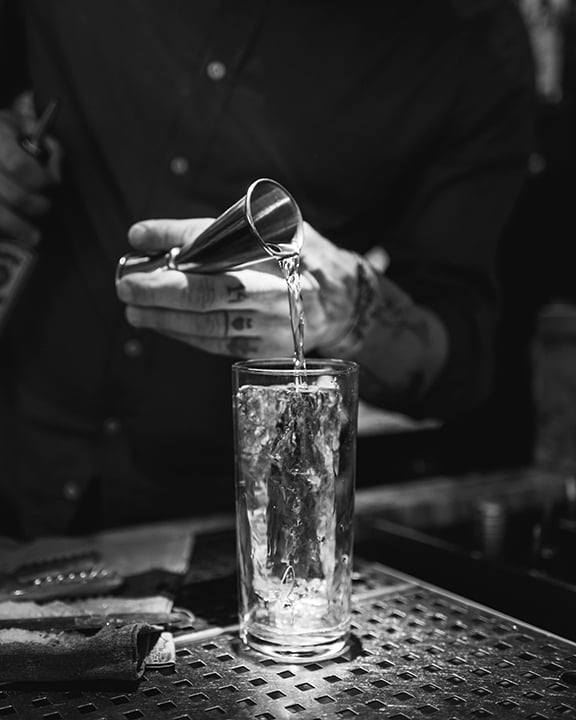
The Highball thrives on temperature and carbonation. Both are quickly lost if you don't work carefully. This sequence has proven effective:
- Chill the glass: Fill a tall, narrow glass with ice, stir briefly, and pour off any meltwater. Alternatively, place the glass in the refrigerator beforehand.
- Add ice: Fill the glass generously with clear, preferably large pieces of ice. Large pieces melt more slowly and dilute less.
- Measure whisky: Pour the whisky over the ice and stir briefly so that it takes on the temperature of the ice.
- Top up with soda: Slowly pour ice-cold soda water along the rim of the glass or over a spoon to minimize the loss of carbonation.
- Stir once: A single, gentle pull with a bar spoon from bottom to top is enough to combine everything.
A lemon or yuzu zest is optional. It's not a mandatory ingredient but can enhance the fresh impression.
The Right Ratio
There is no single valid mixing ratio. As an editorial starting point, one part whisky to three to four parts soda works well: robust enough to recognize the whisky, light enough to be truly refreshing. From there, adjustments can be made in both directions.
- Stronger: Less soda if the whisky is milder or you want more structure.
- Lighter: More soda if the whisky is very aromatic or the drink is meant to accompany a meal.
In addition, there are two terms that appear repeatedly and should not be confused with the standard Highball. Half up refers to equal parts whisky and soda, making it significantly more concentrated than a classic Highball. Twice up means whisky and water in equal parts, without ice, and is typically consumed for attentive tasting rather than refreshment.
Which Japanese whisky fits?
Fundamentally, not every whisky works equally well in a Highball. As a guide:
- For beginners: an accessible, rather fruity-mild profile without dominant smoke. Such whiskies tolerate dilution without appearing thin.
- Very aromatic or smoky bottlings: it's better to use a little less and add more soda, otherwise the balance quickly shifts.
- Cask-aged whiskies: If you want to get to know Japanese cask types, Mizunara is a topic of its own. Japanese oak is porous, ages slowly, and can contribute notes of frankincense, vanilla, and coconut. Such whiskies are exciting, but in a Highball, they require careful dosing so that the delicate wood notes do not disappear.
You can best see which bottles are currently available from us directly in the assortment.
The Most Common Mistakes
- Warm soda: Room-temperature water immediately releases carbonation and melts the ice. Soda belongs in the glass chilled.
- Too little ice: A few cubes melt quickly and dilute the drink. A well-filled glass stays cold longer.
- Stirring too vigorously: Every extra movement costs effervescence. A single, gentle stir is sufficient.
- Too much whisky: A Highball should be light. If you pour too generously, you end up with a diluted dram instead of a long drink.
- Wrong water: Still or lightly sparkling water does not make a Highball. It requires strongly carbonated soda water.
Highball at Home and with Food
The Highball is uncomplicated and therefore a good aperitif: quick to make, cold, with a moderate alcohol content. In our editorial experience, it also pairs well with salty, fried, or grilled dishes, because the carbonation keeps the palate fresh between bites. This is a recommendation, not a dogma: if you prefer to drink neat whisky with your meal, you're not doing anything wrong.
If you're hosting several guests, it's worth chilling the ice and soda beforehand and preparing each glass individually. A Highball prepared in advance loses exactly what makes it special within minutes.
Sources & Further Reading
- Stephen Lyman and Chris Bunting: The Complete Guide to Japanese Drinks: Sake, Shochu, Whisky, Beer, and More, pp. 192, 194, 308–309.
- Brian Ashcraft: Japanese Whisky, pp. 90–101.
- Dave Broom: The Way of Whisky, p. 7.