
The importance of cask selection in Japanese whisky production
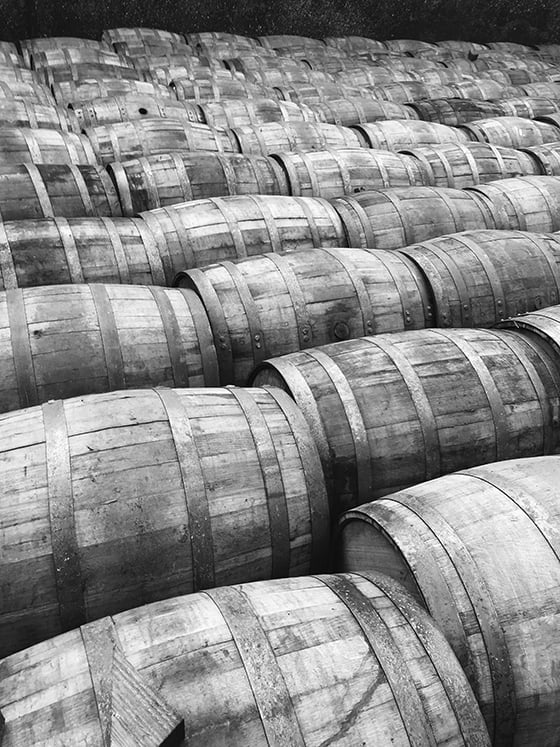
When tasting Japanese whisky, you almost always taste a cask in the end. Whether it's vanilla, dried fruits, or a hint of temple smoke – most of the aromas that define the taste don't come from the still, but from the wood in which the spirit matures for years. Choosing the right cask type is therefore one of the most important decisions in Japanese whisky production.
Ex-Bourbon: The Foundation of the Japanese Whisky Industry
By far the most common cask type in Japan is used Bourbon barrels made from American white oak (Quercus alba). This has a very practical background: in the USA, a law stipulates that Bourbon barrels must be new and can only be used once. This creates an enormous second-hand market, which Japanese master distillers also utilize.
Ex-Bourbon casks mature relatively quickly and impart vanilla, coconut, and caramel notes to the whisky. Suntory and Nikka primarily use these casks because they provide a reliable base for the distillate without dominating it. At Nikka, an estimated 70 percent of the casks in storage are classified as Bourbon barrels.
One advantage of Bourbon barrels is their consistency: if a specific flavor profile is desired, used Bourbon barrels can be used in a planned manner. Therefore, they form the foundation for many blends and single malts – even if they rarely take center stage in marketing communications.
Sherry Casks: Dark Fruit and Structure
In addition to Bourbon casks, Sherry casks play an important role, especially for blends that need structure and richness. Maturation in former Oloroso or Pedro Ximénez casks brings dark dried fruits, spices, and tannins to the whisky.
The history of the Karuizawa distillery shows the role Sherry casks could play: the team specifically used them to give the spirit the necessary "muscle mass" for the Ocean blends. However, experts warned against leaving Sherry casks for too long – over-extraction was a real problem. Some of the famous Karuizawa bottlings from recent years were controversially discussed precisely for this reason.
Today, most Japanese distilleries use Sherry casks specifically as a finish or as part of the blend to add complexity without overshadowing the Bourbon character.
Mizunara: The Japanese Secret Weapon
No wood is as associated with Japan as Mizunara (Quercus crispula), the Japanese oak. Mizunara casks are considered one of the rarest and most expensive options in whisky production – and for good reason.
The wood is extraordinarily porous, leading to high evaporation loss ("Angels' Share"). Maturation takes significantly longer than with other cask types, and coopering is difficult because the wood structure differs from American oak. What makes Mizunara unique, however, are its aromas: sandalwood, incense, and coconut – a scent that Japanese master Seiichi Koshimizu once described with the formula "It smells of temples".
At Suntory, Mizunara casks are used in the famous Ohmi warehouse, where they impart their distinctive notes to Yamazaki and Hakushu bottlings. Mizunara is not a cask that is used casually – it requires patience, experience, and a deep understanding of the interaction between wood and spirit.
If you want to learn more about the special properties of this wood, you can find details in our article on Mizunara and Japanese oak.
👉 Discover Japanese Whisky with Mizunara Maturation
Virgin Oak: Strong Wood Notes from New Wood
While used Bourbon casks impart gentle aromas to the spirit, some distilleries use unused oak wood (Virgin Oak). Nikka began using Virgin Oak casks around 1990 – especially for Yoichi, whose robust distillate can handle the power of new wood.
Virgin Oak imparts pine resin, cedar notes, and intense vanilla. The best Yoichi single-cask bottlings come from 20-year-old and older Virgin Oak butts – a testament to the fact that this wood can yield great results with the right foundation.
Nikka's Tochigi Cooperage specializes in Virgin Oak butts and is a good example of how Japanese distilleries build their own expertise instead of relying on imported solutions.
Further Experiments: Wine, Shochu, and Umeshu
Japanese master distillers are not standing still. In addition to classic cask types, intense experimentation is underway with alternative wood types and fillings:
- Wine casks: From Yamanashi and other wine-growing regions, for fruity notes
- Shochu casks: for unusual, slightly sour nuances
- Umeshu casks: chrysanthemum wood from plum wine production, for a six-month finishing phase
- French oak: for more elegant, finer aromas
These experiments show the creativity of the Japanese whisky scene – and that cask selection is not limited to four standard options.
Climate and Storage: The Forgotten Factor
An often-overlooked aspect is the influence of the storage climate. Japan spans several climate zones, and temperature differences directly affect maturation. Heat accelerates extraction from the wood – whisky matured in warmer regions like Kagoshima develops differently than that in cool locations like Hokkaido.
Some distilleries deliberately store casks in different regions to achieve different maturation profiles. The Akkeshi distillery in Hokkaido, for example, has started experiments in Furano to investigate the influence of a different environment.
The type of warehouses also plays a role: dunnage-style warehouses with thick earth offer different conditions than modern steel buildings. Which style is better depends on the desired result – there is no universal answer.
Conclusion: A Cask is Never Just a Cask
Cask selection in Japanese whisky production is far more than a technical decision. It is a creative endeavor that requires experience, understanding of climate, and a feel for the interaction between wood and spirit. Whether it's ex-Bourbon as a reliable base, Sherry for structure, Mizunara for unique Japanese notes, or Virgin Oak for bold experiments – each cask type tells a different story.
However, the choice of cask type is only the beginning. The master distiller must decide when the whisky is to be removed from the cask, whether a transfer to another cask makes sense, and how long the finish should last. These decisions require years of experience and a deep understanding of the chemical processes that take place in the cask.
When you open the next bottle, it's worth listening carefully. The aromas in the glass are the result of years of work – from the wood selection to the patience it takes until the cask reveals its secrets.